Wednesday, April 25, 2012

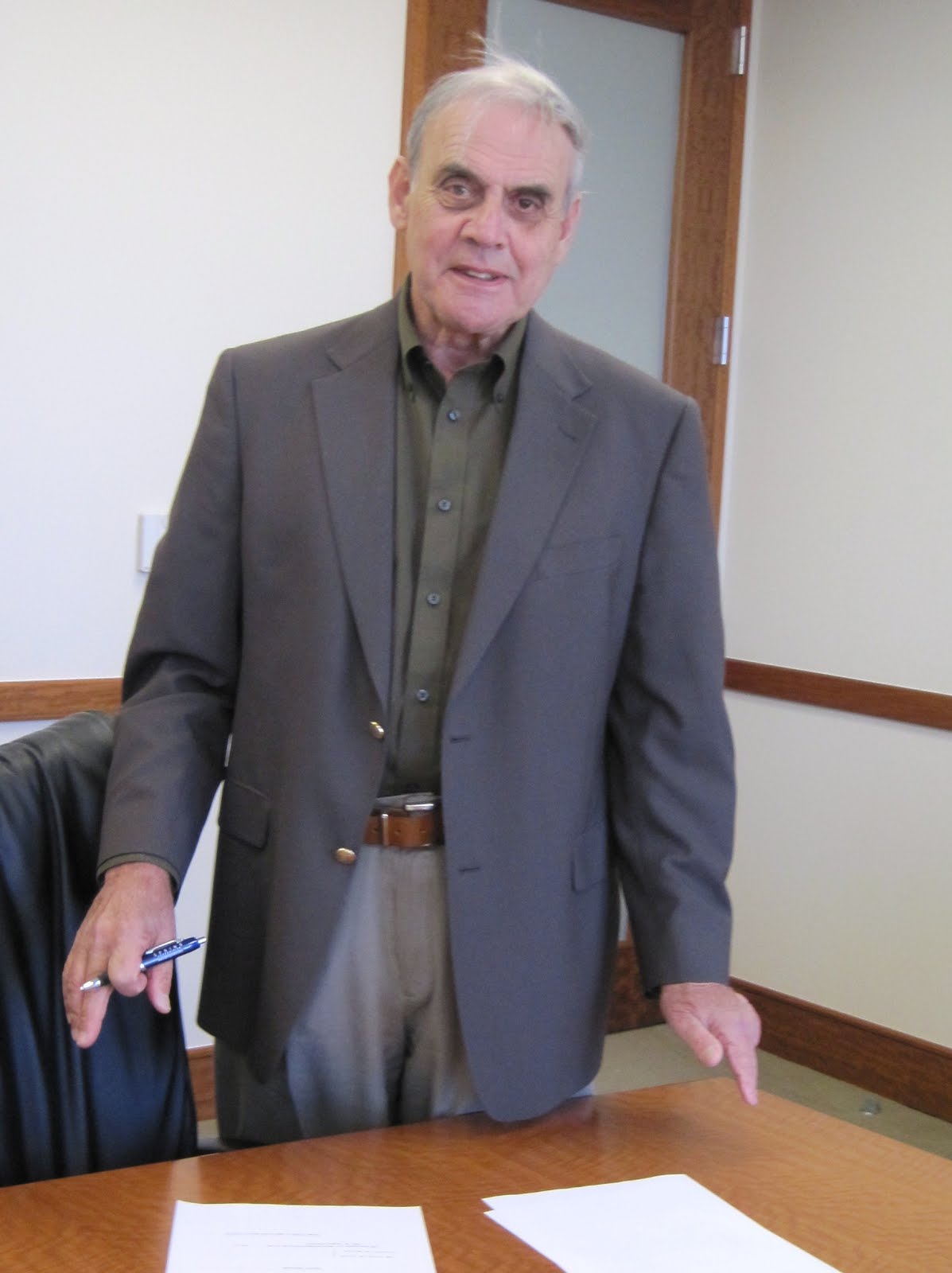
George F. Bass


Texas A&M Distinguished Professor Emeritus of Nautical Archaeology and founder of the Institute of Nautical Archaeology, George F. Bass, has been elected a 2012 fellow of the American Academy of Arts and Sciences, a prestigious honorary society and a leading center for independent policy research.
In his more than 30 years of research and teaching, Bass made many noteworthy contributions to the field. He began diving in 1960, and that same year he became the first person to excavate an ancient shipwreck in its entirety on the sea bed. At the end of the excavation, Bass established a museum of underwater archaeology in the Bodrum castle in Turkey, which is now one of the most popular attractions in Bodrum. He has since excavated a number of shipwreck sites ranging from the Bronze Age through the eleventh century. He has also directed or assisted with prehistoric terrestrial excavations in Greece, Turkey, and Italy.

Throughout the years, Bass has written ten books including Serce Limani and Yassi Ada and has also received many awards and accolades for his preeminent achievements. He has been awarded the Archaeological Institute of America's Gold Medal for Distinguished Archaeological Achievement, the Historical Diving Society’s Pioneer Award, an Explorers Club Lowell Thomas Award, a National Geographic Society La Gorce Gold Medal as well as the Society's Centennial Award, the J.C. Harrington Medal from The Society for Historical Archaeology, and honorary doctorates from Bogaziçi University in Istanbul and the University of Liverpool. In 2002 President George W. Bush presented him with the National Medal of Science.

Tuesday, April 24, 2012

2012 Distinguished Achievement Awards

COLLEGE STATION— This year Texas A&M University and The Association of Former Students have selected 24 outstanding members of the university's faculty and staff to be honored with the 2012 Distinguished Achievement Award. In recognition of their achievements, each recipient will receive a cash gift, an engraved watch and a commemorative plaque.

The Texas A&M University Press would like to congratulate Michael Waters, author of Clovis Lithic Technology and Lone Star Stalag as well as Press Faculty Advisory Board member Barbara Gastel for their receipt of the Distinguished Achievement Award.

Michael Waters is a professor of anthropology and geography at Texas A&M University and director of A&M’s Center for the Study of the First Americans.

Barbara Gastel, a physician specializing in biomedical writing and editing, is professor of integrative biosciences, humanities in medicine and biotechnology at Texas A&M University, where she coordinates the master's degree programs in science and technology journalism.

Tuesday, March 20, 2012

Athena Kashyap Answers Questions About Her Forthcoming Book, Crossing Black Waters


Crossing Black Waters (Stephen F. Austin University Press) by Athena Kashyap, is an exploration of borders through one family's personal odyssey from the violent upheaval of the Partition of India in 1947 to emigrating to the U.S. The book delves into the psychological impact of leaving behind a past that keeps "pulsating behind swinging shutters of thought" to recreate lives and identities anew, and searches for "home"--a "lonely room in the [my] mind," a "heartache" at the "end of rainbows," or else a fictitious "country," built around "hubs" of friendships forged over "glasses of wine and tandoori chicken." A key phrase is "I am knot"--the "not" of borrowed identity coupled with the idea that one cannot truly be separate and is "knotted" with the past for life.

Texas A&M Press: What was your inspiration for this book?

Kashyap: Writing the poems for this book, I found myself drawn to exploring my place in America, trying to carve out a niche for myself in a new country. As an immigrant, the process of fitting into your new environment is more deliberate as locals perceive you as an outsider, especially if you look and speak differently. You have to assimilate your own past and integrate it with the present reality of living in a different culture...this often involves a redefining of your identity (depending upon your age and your interest in assimilating of course). The beauty of living in the U.S., and especially San Francisco, is that there are many other immigrants so you are far from alone in this quest. My poems about Noe Valley, the neighborhood I lived in San Francisco, delve into my interactions with store keepers, cafe' owners as an immigrant and outsider, but one interested in finding her way into their lives.

I found myself also thinking about my family's migration during the partition of India into India and Pakistan in 1947 and juxtaposing these poems alongside those of my own migration. While the migrations were for different reasons--my family was forced to leave Lahore because of political reasons, while my own decision to come to the U.S. was a conscious choice to broaden my opportunities, in both cases there was a similar searching for the homes we left behind. Several of my poems explore what "home" might mean, even if it is just "a lonely room in the mind."

I am also interested in understanding more about borders of different kinds--national, between self and other, geographic, and also between life and death, and the poem and the page. My father's death at age thirty-nine, when I was nine years old, was a life-changing event, and a couple of poems in the book focus on loss--loss of a child, loss of a father. I investigate the boundaries between life versus death, and reality versus fantasy/myth/or art. A few of my poems also lie between poetry and prose, and some scatter words on the page, questioning the supremacy of line, blurring the traditional notion of poetry.

Lastly, the concept of "black waters," derived from the Indian notion of leaving what has always defined you to lose yourself in the unknown, fascinates me. Instead of the horror it invoked in the past, of losing your caste privileges and identity, I embrace this as a wonderful thing. Leaving home is as painful as breaking up with your first love, but as the world grows smaller, more and more people have more than one home and have been more than one person in their life-times. Piecing together who you were at different times and places and seeing a pattern emerge out of it is a new way of looking at your identity.

TAMU PRESS: Were there any specific figures, poets, or events that influenced your work?

Kashyap: I've always liked Whitman, though I have also been attracted to contemporary poets such as Rimbaud, Barbara Guest. I work a lot with sound, so I am drawn to lyric poetry. At the same time, I enjoy experimenting with the page as an artist's canvas, seeing how the placement of words might impact their meaning.

TAMU PRESS: What audience do you believe will benefit most from/be most interested in this book?

Kashyap: Anyone who lives or has lived in more than one country, for whom "home" has not remained constant.

Crossing Black Waters is set to publish in April of 2012
                                                                           
"crossing black waters"

Once she stepped outside, her skin
dissolved. She struggled to stay

afloat, but years distanced her
from the caress of the Ganges

that once swept her plains, hum
of her hidden Himalayan caves,

she grew weak. Yet, when
she was about to drown

webs of seed, teeth and hair
unraveled to release her,

let her float away, guided only
by loose, unkempt stars.

Monday, March 19, 2012

T. Edgar and Nancy Paup Marketing Intern

COLLEGE STATION—Texas A&M University Press has named Kelsey Lawrence, an English major from Austin, Texas, the T. Edgar and Nancy Paup Marketing Intern for 2012.

This position was established by a generous gift from T. Edgar "Ted" Paup '74 and his wife Nancy, enabling the Press to recruit a talented, energetic student worker to assist with inventory management and related marketing responsibilities of Texas A&M Press and the six other Texas scholarly publishers in its distribution consortium. The Paup gift not only benefits the Press but also substantively supports the educational goals and ambitions of a worthy Texas A&M student.

After receiving a Bachelor of Arts degree in English literature from Texas A&M in December, Lawrence has taken on these new responsibilities at the Press, welcoming the opportunity to expand her knowledge and practical experience in publishing, the field in which she hopes to make her career. These additional credentials were helpful in her recent acceptance into the master's degree program in Publishing & Writing at Emerson College, in Boston, Massachusetts, and also the master’s degree program for Publishing: Digital and Print Media at New York University. Lawrence is planning to visit both campuses before enrolling for the Fall semester.

Ted Paup's mother, Chan Driscoll, was a founding member of the Texas A&M University Press Board in 1978 and served on this important support organization until her death in 2007. Now, Ted is an active member of the Texas A&M Press Advancement Board, continuing his mother’s legacy of supportive, engaged interest in the Press’s publications program.

Wednesday, March 7, 2012

Townes Van Zandt is Inducted into the Texas Heritage Songwriters Hall of Fame

On March 4th, the late Townes Van Zandt, along with Lyle Lovett and Robert Earle King, was inducted into the Texas Heritage Songwriters Hall of Fame at Austin City Limits Live at the Moody Theater in downtown Austin. The event was celebrated with performances by Lyle Lovett, Robert Earle King, and Steve Earl, who sang Van Zandt’s songs. Van Zandt’s award was accepted by his son, J.T. Van Zandt. 

The writer of such influential songs as “Pancho and Lefty,” “To Live’s to Fly,” “If I Needed You,” and “For the Sake of the Song,” Townes Van Zandt exerted an influence on at least two generations of Texas musicians that belies his relatively brief, deeply troubled life. Van Zandt has influenced millions worldwide in the years since his death, and his impact is growing rapidly.
"The kinds of songs that Townes was writing in those days were really pieces of literature," Lovett told the Austin American Statesman. "It really was art. That was the standard that was set in those days for the places I used to go and listen, and the places I aspired to play."

If you are interested in the life and music of Townes Van Zandt, check out the Texas A&M Press book, I’ll Be Here in the Morning by Brian T. Atkinson.

Atkinson interviews both well-known musicians and up-and-coming artists to reveal, in the performers’ own words, how their creative careers have been shaped by the life and work of Townes Van Zandt. Kris Kristofferson, Guy Clark, Billy Joe Shaver, Rodney Crowell, Lucinda Williams, and Lovett are just a few of the established musicians who share their impressions of the breathtakingly beautiful tunes and lyrics he created, along with their humorous, poignant, painful, and indelible memories of witnessing Van Zandt’s rise and fall.

Thursday, February 23, 2012

Texas A&M Press Author Liz Carmack Gives Excellent Advice on Promoting Books

By: Liz Carmack, author of Rodeo Austin (Texas A&M Press, 2012)

As an author, your efforts to promote your nonfiction book are every bit as important as the work you put into writing it. If you realize a few facts about the process and include a few key tasks in your to-do list, it can make your life easier and help your book achieve greater success.


Inconvenient truths

1. The success of your book is largely in your hands. You must take the lead in promoting your work. This includes figuring out (often before you even write the first word) who your target readers are and devising creative ways to reach them. Expect to set up your own book signings and speaking gigs even if you have a traditional publisher.

2. You’d better love, love, love your subject. After spending several months, or years, researching and writing your manuscript you may be sick of your topic. Get over it. Remember why you wrote the book in the first place. Your work will brand you as an authority, and you’ll be expected to speak intelligently and passionately about that subject for years to come.

3. Book signings at book stores are often a waste of time. Unless you’re David Grann or Malcolm Gladwell, folks probably won’t line up for hours at Barnes and Noble to see you. Instead, schedule signings at conferences, festivals or other events attended by your target readers. Signings at independently owned bookstores can be successful if their loyal customers include your market.

4. You can’t wait until your book is published to start promoting. Share details about your evolving manuscript or the trials of your project’s research through blog posts and other social media. Comment on the blog posts of others who write about your subject area. Avoid being overly promotional in your posts. Instead, provide interesting, engaging content. By the time your book is released, you’ll have built a fan base.


Must-dos

1. Have a plan. Early on in your writing, draft a strategic communications plan to promote your book with a scheduled list of to-dos. Clearly define your audience and the best ways to reach them. Include sections on how you’ll use social media, public speaking, face-to-face networking and media outreach. If you have a publisher, coordinate your efforts.

2. Tweak your plan. Stay flexible. When my book Historic Hotels of Texas was released, I booked speaking gigs and book signings with anyone, anywhere, anytime. After I realized that women 40 and older bought more copies than any other group, I targeted organizations with that demographic. I instantly sold more books at those events.

3. If you have the money, hire a publicist. A book publicist experienced in your genre is worth every penny. Interview two or three companies before you select one; I did and then hired PR by the Book. When Historic Hotels of Texas was released, the firm helped me land several radio and TV interviews that I wouldn’t have gotten on my own.

4. Polish your presentations skills. You’ll engage more readers and sell more books if you can combine public presentations with book signings. If you’re not a polished speaker, get help from a speech coach. Offer your presentation to groups whose membership best fits your target market and schedule your own workshops or presentations centered on your book’s topic. Also consider posting videos and podcasts.

I realize that book promotion has many more truths and to-dos than those included here, but I hope this information will at least give aspiring authors a reality check about what’s ahead. What would you add to either of these lists?

Liz Carmack is a freelance writer, editor and researcher. She founded Liz Carmack Communications in 2006. Liz began her career as a newspaper journalist and has also helped craft messaging and manage communications projects for nonprofits and government agencies. Her most recent book, Rodeo Austin: Blue Ribbons, Buckin’ Broncs, and Big Dreams, is published by Texas A&M University Press.

Wednesday, February 15, 2012

12 Impacts of the 12th Man, George P. Mitchell

An energy tycoon, real estate developer, and philanthropist, George P. Mitchell is also an idealist, a big thinker who gave his time and fortune to the study of sustainability long before it became a household word.

This month Mitchell is featured in Texas A&M University's first installment of the 12 Impacts of the 12th Man series, for his contributions to the oil and gas industry.

Jurgen Schmandt, professor emeritus of public affairs in the Lyndon Baines Johnson School of Public Affairs, University of Texas at Austin, worked with Mitchell for many years. He was formerly the director of the Mitchell Center for Sustainabl Development.

His book, George P. Mitchell and the Idea of Sustainability (Texas A&M University Press, 2010), focuses on Mitchell's commitment to the idea of sustainability from the early 1960s, when the focus was on population growth, to today, when climate change and global warming dominate the debate.


Texas A&M University Press: George P. Mitchell is known, in part, for his contributions to the oil and gas industry, as well as for his visionary real estate ventures, and his untiring support of scientific endeavors. Your book, however, focuses on his commitment to the idea of sustainability. How do his contributions to sustainability compare in range and scope to his other achievements? Are his efforts in this area as widely known?

Schmandt: George Mitchell excelled in three careers, which he pursued in parallel — energy, real estate and philanthropy. He created one of the largest independent energy companies. He built a community —The Woodlands — that followed the principles of Design with Nature. And he devoted his fortune to public causes — sustainable development and science. He is well known in all three fields, but by different constituencies.

TAMU Press: What influenced you to cast Mitchell as the focus of this book?

Schmandt: George is one of a handful of successful businessmen who saw early on that population growth and ever-increasing consumption were threatening the resource base of our planet. I felt that it was worthwhile to document his commitment to sustainable development.

TAMU Press: What are some of the lasting impacts of Mitchell's contributions to sustainability?

Schmandt: In the '70s and '80s, Mitchell familiarized American decision makers and scholars with sustainability research that had been pioneered in Europe under the heading Limits to Growth. Mitchell, through conferences, prizes and sponsored research broadened the focus of this debate: not no-growth but sustainable growth — improvements in the quality of life that do not endanger the resource base of future generations: food, energy and work. Then he tried to bring these ideals to Washington. He wanted the government to take the first step: keeping track of changing conditions. This did not work. So he turned to the National Academy of Sciences and helped them develop the scientific and engineering underpinnings of sustainable development. Today he supports sustainability projects through the Cynthia and George Mitchell Foundation.

TAMU Press: You worked for Mitchell for many years. Why do you think he was so motivated to advance these ideas?

Schmandt: He always searched for answers to urgent questions. Early on he read Rachel Carson, who warned against the overuse of DDT. The breakthrough came when he met Buckminster Fuller. His image of Spaceship Earth — the world can take only so many people — impressed him deeply. He would say: protection of the environment is important. But you have to aim a notch higher: protection of the planet, sustainable development.

TAMU Press: You note in your book that while Mitchell made many strides to advance the idea of sustainability through the creation of conferences and prizes, support of scholars and scientists, and funding of research and publications, he did not take measures to advance sustainability in his own energy company. Through your research were you able to discover why this was the case? What did you discover?

Schmandt: Ray Anderson, a Mitchell Prize winner, rebuilt his carpet business around green principles, and found that he could do so profitably. Mitchell did not follow this path, probably because he did not see how to build a green energy company. Or better: he saw only a partial way to this goal. For twenty years he pioneered the extraction of shale gas. The large companies said it could not be done economically. Mitchell persevered. He argued that gas emits less carbon dioxide than coal and oil and should be used more widely, while work on alternative energy sources — wind, solar, bio fuels—is being up scaled. Today, because of his work, the United States has increased its energy independence and has become a gas exporter. And shale gas is being produced worldwide.

TAMU Press: In the future, will Mitchell be remembered for his commitment to sustainability? Why or why not?

Schmandt: Yes, if the world commits to sustainability. No, if we continue to do business as usual.