Tuesday, December 18, 2012

Texas Medical Center President to Retire After 28 Years

Dr. Richard Wainerdi has experienced a lot during his 28 years as President of the Texas Medical Center. However, he not foregoing everything he loves. In an interview with Houston Chronicle medical reporter Todd Ackerman, Dr. Wainerdi admitted he is “going to keep [his] hand in a lot of different things…but at 81 years of age and 28 years as president, [he thinks] it’s time to turn the reins over to someone else.”
 
In 1984, Dr. Wainerdi accepted his position as President and CEO after retiring from the Gulf Oil Corporation. However, prior to his tenure there, he spent a previous 20 years at Texas A&M University founding the Texas A&M University's Nuclear Science Center, the Activation Analysis Research Laboratory, the German Synfuels Technology Retrieval Program, the Center for Energy and Mineral Resources, the University's College of Medicine, as well as numerous other programs.
 
Texas A&M University Press author, Frederick C. Elliott, documents many of the changes TMC has experienced over the years in his book The Birth of the Texas Medical Center: A Personal Account (Texas A&M University, 2004). His book reveals the human side to this dynamic organization. Dr. Wainerdi said “Dr. Elliot’s book provides a unique perspective of the creation of the Texas Medical Center. His insight into this historically significant process is of great value to all of those who want to understand how what is now the largest medical center in the world came into being. He was more than simply an observer, he was a vital participant and leader in all that occurred.”
 
For more on Elliott’s book, click here.
For more on the interview, click here.
For more on Dr. Wainerdi, click here.

Monday, December 10, 2012

Museum Offers Macabre Opportunity

 
On December 30th  and 31st, the Mariners Museum in Virginia is offering an unusual opportunity—six winners of an auction will be able to step inside the USS Monitor turret on the anniversary of its sinking, 150 years ago. This Civil War warship has an incredible 120-ton wrought iron revolving gun turret. The individuals bid in an online auction offered by the Mariner’s Museum in Newport News and the Monitor National Marine Sanctuary which ended on December 2. In addition to the turret, the Museum also houses the USS Monitor’s vibrating side-lever steam engine and two XI-inch Dahlgren shell guns and their gun carriages.


To find out more about the history of the USS Monitor and its excavation, TAMU Press’ book USS Monitor: A Historic Ship Completes Its Final Voyage by John D. Broadwater gives its full history. With lavish illustrations, photographs, and site drawings, USS Monitor can be enjoyed by naval warfare buffs, professional involved in maritime archaeology, or Civil War aficionados. Broadwater is a retired chief archaeologist from the National Oceanic Atmospheric Administration’s Office of National Marine Sanctuaries.

Monday, December 3, 2012

The Singing Jesus of Boquillas Canyon


A largely unknown place at the knees of North America, the U.S.-Mexico borderlands region stands at political crossroads. The development of the border wall dividing this region -- a sprawling landscape that has seen the birth of jaguars, the budding of saguaro cactus and the footsteps of a million migrants -- has sparked hot debate, as it relates to illegal immigration, international politics, and the drug war.

In her new book Continental Divide: Wildlife, People, andthe Border Wall (Texas A&M University Press, 2012) author and photographer Krista Schlyer gives voice to a lesser-known aspect of the debate ─ the wall’s destructive impact on wildlife.

Schlyer explains in unforgettable images and evocative text how the wall has not only disrupted the ancestral routes of wildlife; it has also rerouted human traffic through the most pristine and sensitive of wildlands, causing additional destruction, conflict and death ─ all without solving the original problem.

Here, Schlyer – whose previous work has appeared in National Parks, Defenders, National Geographic, and many other publications – explains why experiences in the borderlands region prompted her to devote “most of her working and waking hours to documenting, researching, understanding and communicating the ecological underpinnings of a decades-long failure to craft smart, realistic border and immigration policy.”

For more information on Continental Divide: Wildlife, People, and the Border Wall, visit www.tamupress.com or view the book trailer here.

 
By Krista Schlyer

A dusty trail meanders along the Rio Grande into Boquillas Canyon, a cleft carved by the river between land that is now Texas on one side, and Chihuahua on the other. On that trail there sits a scratched-up old plastic jar beside a note weighed to the ground by a rock. The note reads, “The Singing Jesus. Donations, please.”

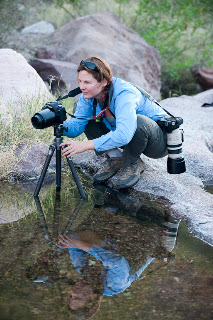
In late October I came across this curious note and jar in Big Bend National Park. Intrigued but having no money in my pockets, I walked on down the trail and set up my camera to capture the light as it stole into the canyon corridor. While I was working, out of the silence came a voice singing from the other side of the river, near the small village of Boquillas in Mexico. My eyes followed the singing voice to the figure of a man, Jesus I immediately assumed, who was crooning a Spanish song I knew well, “Ay, Ay, Ay, Ay. Canta y no llores.” I considered his distant figure briefly and continued working while he sang.

After a moment, I stopped suddenly and listened more intently. Jesus’ voice had begun reverberating off the canyon walls. It traveled to the north side of the canyon in the US and back again to Mexico. Once this symphonic loop was started, it continued as long as Jesus continued singing. And I was riveted, enveloped and arrested, as  I so often am in the borderlands, by the music of two worlds coming together and alive within the landscape.

It was this convergence of cultures--both wild and human since this international border also spans a natural north-south transition between the temperate and tropical zones--that had first drawn me to the US-Mexico border. On this most recent trip to the borderlands I encountered some old friends and made some new ones, including Jesus, all of them reminding me why I started this work five years ago, and why I wrote Continental Divide: Wildlife, People, and the Border Wall.

It all began with a couple of bison bulls who serendipitously crossed the international border at the exact moment I was flying a few hundred feet above them in a small twin-engine Cessna research plane. Wildlife scientist Rurik List, who I had been trailing for a story about a long-lost herd of wild bison found in the arid grasslands spanning New Mexico and Chihuahua, had explained to me the dire predicament a border wall would pose for transboundary wildlife species. But seeing these bison cross the international border en route to their main food resources in New Mexico changed my theoretical understanding of migration pathways, and changed my life. Since that day most of my working and waking hours have been devoted to documenting, researching, understanding and communicating the ecological underpinnings of a decades-long failure to craft smart, realistic border and immigration policy. About the waste of taxpayer money on endless enforcement and infrastructure; about the wildlife who will die if they cannot reach food and water resources on both sides of the border; about the jaguar, ocelot and other imperiled wildlife, whose trajectory toward extinction within our borders will be hastened by choked-off migration corridors; about the more than 5,000 human migrants who have died traversing the borderlands since the 1990s.

My work in the borderlands has unearthed countless stories and images of heroics and heartbreak along the border, many of them contained in the pages of Continental Divide, published last month by Texas A&M University Press.  Some of those stories I am just now learning or will continue to learn in the future, like that of the Jesus and the people of Boquillas.

This trip to Big Bend was my fourth in 10 years to one of the nation’s most isolated national parks, indeed one of the most isolated regions of any sort, in the United States. The trip was going to be short, just a brief stop to observe and document any changes that had taken place since the last time I visited in 2011. As is always the case when I travel to the US-Mexico borderlands, I found much more than I was looking for.

The note written by Jesus was one of dozens that dotted the trail along the Rio Grande. Most of them were written by Mexican artisans and were accompanied by small craft works, caricatures of local flora and fauna fabricated from wire and beads. Beautiful works of art, these scorpions, roadrunners and flower sculptures were accompanied by notes that asked for donations to be placed in plastic cups and coffee tins. This wasn’t always the entrepreneurial approach of the local artists. Prior to 9-11, the town of Boquillas had a thriving trade with the many tourists that came to Big Bend and across the river to Mexico. I myself had walked across the river in 2001 and eaten dinner, prior to the closing of the border later that year. I have often considered the cultural loss for both sides of this border, when the government shut down access, and I remember that first crossing as one of my favorite moments in life. But it wasn’t until this most recent trip that I came to understand the grave economic consequences of that decision by the US government. Boquillas is a small village, hours from the nearest city or border crossing. The lives of people here, the education of their children, their health and well-being depended on tourists and a passable border. One decision made two-thousand miles away cleaved their connection to the United States and eviscerated their economy.

Today, Mexican people cross the river at night or when the coast seems clear, they place their work, and their donation jars, and hope that visitors will engage in trade that was commonplace and essential to their lives. The US Border Patrol calls the craftwork ‘contraband’ and forbids US visitors to buy it. But the artisans keep coming, keep leaving their work, keep checking their plastic jars.

The Singing Jesus has taken a different approach. It would be a hard case to make for the border patrol to call a song contraband--though not unthinkable in the current reality. Jesus sings and hopes people will hear him and his endless echoes and place some money in the jar.

Having no money in my pockets, I was all set to bypass his jar but he stopped singing and made the ask.

            “Will you leave some money for the Singing Jesus?”

            “I’m sorry,” I said. “I don’t have any money with me.”

            He paused for a moment and asked, “Do you have food?”

I looked through all my pockets and my camera bag and all I could find was a piece of candy. I held it up to him, still standing across the river.

            “Will you put it in my jar,” he asked.

            I did.

            “Do you have more food in your car?”

I said I did and watched as he jumped with quick desperation into his canoe and paddled across the river. His demeanor changed as he approached the US shore, his eyes darting about looking for border patrol or park police. I followed him quickly toward the parking lot, on the way he told me how the closing of the border had crushed the village economy, and how he had heard and kept hoping that the border would soon reopen. When we reached the parking lot, he hid behind a rock--getting caught would have serious consequences for him. When border patrol catches crossers from Mexico here, they don’t just allow them to cross back, they arrest them and cart them to a city crossing hours away. Most have no money to get back home.

I grabbed a bag of food and a jug of water from my car, and walked back to the trail, handing it to Jesus. I thanked him for his song and watched him disappear quickly into the canyon.

The story of the people of Boquillas is one that our policy makers and many members of the public need to hear. It is one of many thousands of stories about human and wild communities all along the border that are at the mercy of a federal policy that seems to serve no constituency but continues to be fueled by a politics of misinformation and fear. In hopes of getting these stories to those who need to hear them most, I am seeking funding to purchase a book for every member of Congress and key people in the White House. For the bison, the artisans and visitors to Big Bend, and the Singing Jesus of Boquillas Canyon.        

Click on the Krista Schlyer's fundraising link here!

Wednesday, November 28, 2012

Frito Pie at the Smithsonian?


Kaleta Doolin, TAMU Press author and granddaughter of Fritos founder C.E. Doolin, recently appeared at the Smithsonian food exhibit in Washington, D.C. The Fritos story was included in a section titled, “Snack Nation.” The museum displayed many “Fritos” collectibles, including the Frito kid figurine, a corn-shell shaper and fryer, some photos of Casa de Fritos, a Fritos display from 1950, the covers of the Recipes and Menus for Buffet Entertaining with Fritos by Daisy Dean, and a photo of the production line in Los Angeles.

Doolin was present at both the press conference and a book signing of her book, Fritos Pie: Stories, Recipes, and More (TAMU Press, 2011) after the private opening of the exhibit.


To see pictures and read more about TAMU Press author Kaleta Doolin’s honor at the Smithsonian, check out the Dallas Morning News website.

--Madeline Loving

Tuesday, November 20, 2012

The First Thanksgiving: Fact or Fiction?


Think you know everything there is to know about Thanksgiving and its traditions? What about the first Thanksgiving—was it really an event that we have seen depicted in paintings and school textbooks? Probably not. Americans have adapted and changed the celebratory holiday even further from the “traditional” Thanksgiving to fit their own preferences. These can include gathering with family and reminiscing on all the things their thankful for, running a turkey trot race, watching football, or even eating Mexican food.  However you celebrate Thanksgiving, you can learn the truth behind the myths associated with the first Thanksgiving. We’ve provided a few below!


Myth #1 The Pilgrims dressed in black and white, wore pointy hats and bonnets, and had gold square belt and shoe buckles.
No one really knows where we got this image from. Although the Pilgrims wore black on Sundays, they wore other colors every other day. These included green, white, gray, and brown. Another false image America has produced is the attire of the Native Americans. They covered up a lot more than what America depicts in its Thanksgiving décor. It was freezing cold in the Northeast during the fall—they were fully covered!

Myth #2 The first Thanksgiving meal was served on a big, long table on many large serving dishes.
The first Thanksgiving “meal” was not a sit-down occasion. It was a celebration that lasted over the course of 3-4 days. The food was eaten sporadically; whenever someone was hungry. It wasn’t on a long table eaten with plates and forks either—they didn’t have forks. The food was placed on any flat surface available, and diners grabbed what they wanted and ate with their hands.


Myth #3 The Pilgrims and Indians ate Turkey on the first Thanksgiving.
There probably aren’t too many people who still eat what was eaten at the first Thanksgiving. Although it’s possible they could have eaten Turkey on the first Thanksgiving, there is no evidence to support it. The only thing historians know for sure they ate was “venison and wild fowl.” It is quite possible there was dried fruit and corn there as well. But there were no potatoes, cranberry sauce, turkey, dressing, or pumpkin pie, that’s for sure!


Myth #4 The Pilgrims and Puritans were the same thing.
They most definitely were not the same thing. The Pilgrims came on the Mayflower and settled in Plymouth. They came in search of riches, a utopian land, as well as for religious reasons. A decade later, the Puritans came and lived in Boston. The Puritans came solely to be able to practice their religion freely. They believed there was hope in church reform, unlike the Pilgrims. They both share in common their hate for the Church of England.

 
Myth #5 Thanksgiving was about family.
The first thanksgiving was not a family affair. It was a multicultural gathering. All that is recorded is by the Plymouth Colony Governor, Edward Winslow, who wrote that the colony had dinner with Chief Massasoit and 90 of his men.

To read more on these popular Thanksgiving myths, check out the Top 10 Myths About Thanksgiving and Thanksgiving Day Myths on the History News Network website.
 
 
Happy Thanksgiving from TAMU Press!
 
--Madeline Loving

Friday, November 16, 2012

Best of TAMU Press

Best of University Press: Charles Backus Edward R. Campbell ’39 Press Director

1. Race?  Debunking a Scientific Myth, by Ian Tattersall and Rob DeSalle (2010)
Named to the shortlist of the Royal Society's Winton Prize for Science Books and praised by American Scientist as "a beautifully presented book, elegantly reasoned and skillfully written," this volume by eminent authors at the American Museum of Natural History is an exemplary distillation of best scientific research for a general audience, creating a forceful argument that "race is little more than skin deep in scientific terms."

2. The Country Houses of John F. Staub, by Stephen Fox, photographs by Richard Cheek (2007)
Aside from the book's magnificent photographs and exquisite production standards, this award-winning volume does more than recount the important and distinctive work of Houston's favorite architect.  It also provides a brilliant and perhaps the fullest social history of that city's emerging elite during the twentieth century.

3. The Two Thousand Yard Stare: Tom Lea's World War II, by Tom Lea, edited by Brendan M. Greeley Jr. (2008)
This book offers the unforgettable images and equally compelling words of Tom Lea, created during his World War II assignments as an artist-correspondent for Life magazine, from the North Sea to the South Pacific.  It is a beautifully edited and designed volume, a haunting evocation of war through art.

4. With Santa Anna in Texas: A Personal Narrative of the Revolution, by José Enrique de la Peña (1997)
If there is a single book for which Texas A&M University Press is widely noted, it is probably this translated eyewitness account of the fundamental battles from which Texas emerged as an independent state.  It is also one of the few university press books to earn both commendations and death threats for its publisher.

5. The TOS Handbook of Texas Birds, by Mark W. Lockwood and Brush Freeman (2004)
This rich resource, compiled in association with the Texas Ornithological Society, is the Texas birders' bible—and, because Texas is such an important birding mecca, an authoritative source for ornithologists throughout North America and the world.

Best of TAMU Press:

Best of University Press: Dianna Sells, Financial Manager, TAMU Press

1.      If I remember correctly, the first book released for publication was Storms Brewed in Other Men’s World (TAMU Press 1981)  by Elizabeth John. This is the first book that I remember being released and the beginning of my career with the Press; so, I would choose it because it is symbolic of my career and the successful publishing program of TAMU Press.
 
2.      Then, I would choose Texas Heartland because of the printrun & the design process involved.  Second book published, also in 1975.
I said that we would have to reprint the book within 3 months and we ran out in that timeframe; no one believed me.  James (Jim) Bones was a perfectionist and he had the pages and redid the entire book when Ray accidentally sent him the markup without keeping a copy.  Ray, our designer, had to redesign the entire book. 
3.      Then, I would have to choose BlackJack by Frank Vandiver.  He was such a pleasant person to work with and it began our military history presence.  Frank became the president of Texas A&M University.   At one point, Frank and his wife, Margaret, lived downstairs in our old office building, the board of directors building.

4.      Then, I would choose With Santa Anna in Texas.  The introduction to our Texas History list.  A seller to this day and a notable history book that has stood the test of time.  Third release, in 1975.

5.      Of course, there would be the Centennial History of Texas A&M and the PictorialHistory of Texas A&M, because they established our Centennial Book Series and were the first history books published by the press.


6.      And, then I would choose E M (Buck) Schiwetz portfolio and books.  He was the Texas A&M artist in residence when I came to work at the Press.  He was commissioned to paint the buildings, so we decided to put together the Aggieland Portfolio, which was not a book, but prints of the paintings. He lived down stairs in the old board of directors’ building, the original building in which Texas A&M University Press was housed.  I would spend my lunch hour watching Buck paint and we would go to McDonalds and eat a Big Mac together.  He was such a character and would tell me his life stories.  I remembered the story he told me about a lady coming up to his dinner table one night at a nice restaurant in Houston and she asked him to sign her napkin.  He was “not very happy” about it.  He couldn’t even eat lunch alone.
 
So, when we had the big gathering of authors for a signing at the library we had many an author there.  I walked up to Buck in this large audience and said, “would you please autography my hand?”  He laughed and signed it with a permanent marker.  Then, author and Houston Chronicle columnist Leon Hale grabbed my other hand and signed it also with a permanent marker.

7.      Grasses of Texas by Frank Gould.  Frank was a wonderful teacher and leader in this field and a contributor of permanent knowledge

8.      I would have to choose the Tom Lea book, The Two Thousand Yard Stare, because of his many talents and the fact that he created the TAMU Press logo.  He was such a wonderful person to meet and know and a talented, well-known artist.

9.      And, I can’t forget about Leon Hale’s books because he was an Amazing Writer and a personal friend to me.
Now as for some of my recent favorites—
10.  DOUGWELSH, I have been an avid fan of his for decades because I love gardening.

11.  Heirloom Gardening in the South—Welch and Grant