Tuesday, July 26, 2011

Ma Ferguson Featured in Texas Highways

The August issue of Texas Highways has an article about Miriam “Ma” Ferguson. Ma was the second woman in the United States to take an oath to office and the first female governor of Texas. The first time she ran for office she didn’t know until her husband announced her candidacy to the press. She told voters that said she would follow the advice of her husband and Texas thus would get "two governors for the price of one." As a governor for two terms, she tackled some of the tougher issues of the day.

To learn more about Ma Ferguson, read Hood, Bonnet, and Little Brown Jug: Texas Politics, 1921-1928.


" Captures the rough 'n' tumble nature of Texas politics in the 1920s when three main issues--the Ku Klux Klan (Hood), `Ma' Ferguson (Bonnet), and Prohibition (Little Brown Jug)--were the focus of attention. . . . the Texas political state, always fascinating and colorful, comes to life in Brown's book." --Southern Historian

Ya dig?!

A group of student researchers at Texas A&M are currently working and living together Monday thorugh Friday in a mini tent city a few hundred yards away from their excavation site in Central Texas. They are dedicated to their archaeological dig in search for more “early-man-in-America” artifacts.


Their dig is enhanced by having Dr. Michael Waters as their leader. Waters is the director of the Center for the Study of the First Americans, the Texas A&M-based entity that operates in various locales throughout North America and, perhaps, eventually in South America. Texas A&M University Press publishes books for the center, including Clovis Lithic Technology: Investigation of a Stratified Workshop at the Gault Site, Texas, which will be available in October of this year.

Clovis Lithic Technology includes research and findCentral Texas, near the banks of Buttermilk Creek. These early hunter-gatherers camped, collected stone, and shaped it into a variety of tools they needed to hunt game, process food, and subsist in the Texas wilderness. They left thousands of pieces of debris, which have allowed archaeologists to reconstruct their methods of tool production. Along with the faunal material that was also discarded in their prehistoric campsite, these stone, or lithic, artifacts afford a glimpse of human life at the end of the last ice age during an era referred to as Clovis. Clovis Lithic Technology provides the technical data needed to interpret and compare this site with other sites from the same period, illuminating the story of Clovis people in the Buttermilk Creek Valley.

The area where these people roamed and camped, called the Gault site, is one of the most important Clovis sites in North America. A decade ago a team from Texas A&M University excavated a single area of the site—formally named Excavation Area 8, but informally dubbed the Lindsey Pit—which features the densest concentration of Clovis artifacts and the clearest stratigraphy at the Gault site.

Now, students are working together to excavate more artifacts and important information lying in the walls of their dig. Watch this exclusive segment featuring Waters and students at the excavation site.

“The students are learning archaeological skills that they will later need and have the opportunity to see and discuss the artifacts as they emerge from the earth. At the same time, the time depth of the human presence in North America is pushed back, with all this learned from the tip of a trowel.”

– Michael Waters, Student Researchers At Texas A&M-led Dig Search For More Early-Man-In-America Artifacts, Aggie Hotline

Want to know more about the dig? Read this article featured on Aggie Hotline!

Growing Up in the Spectre of Space Travel

Most children grow up in awe of the deep space, spending their summer days looking up at the sky. You look up at space and it’s never ending, full of twinkling stars you want to touch.

Today I don’t have much time to look up at space. But I remember when I was growing up, people would ask, “What do you want to be when you grow up?” Every time my answer was the same, “I want to be an astronaut.” I wanted to be in space, exploring every inch of it. For three years in a row I dressed up as a Star Trek character, thinking it was just a matter of time before I would join them on the USS Enterprise.

In school, I quickly learned science was not my strong suit. I was a far cry from the top Candidates NASA picks for space travel. So, I soon realized I would never realize that dream, and I put aside future thoughts of being an astronaut in space.

Earlier this month, NASA launched its last shuttle. It was a sad moment, knowing my childhood dream was dying ─ not just my dream, but the dreams of all aspiring astronauts. That day I went home and had a space movie marathon, allowing myself to cry just a few times.

Are you interested in space history?

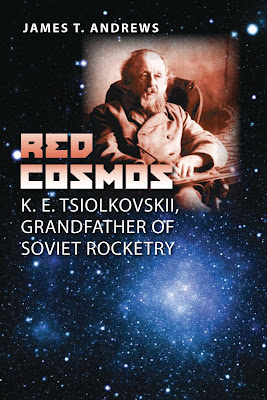
In 2009 Texas A&M University Press released Red Cosmos: K. E. Tsiolkovskii, Grandfather of Soviet Rocketry. Tsiolkovskii conceived multi-stage rockets that would later be adopted as the basis of U.S. and Soviet rocket programs.

Author James Andrews, an associate professor of modern history at Iowa State University, explores Tsiolkovskii life as a science popularizer, novelist, and visionary, whose science fiction writings included futuristic drawings of space stations long before they appeared on any engineer’s drawing board.


". . . the story of a man with a vision for the future. Konstantin Tsiolkovskii . . . opened the door to the space age and built the foundation of rocket science."-Sergei Khrushchev, Brown University

"James Andrews has made a genuine contribution by taking Konstantin Tsiolkovskii out of endless debates over 'who did what first?' to a deeper understanding of this rocket pioneer in the context of Russian history and culture."-Loren Graham, Massachusetts Institute of Technology

Kudos to Texas Review Press Authors!

Brian Carr, author of Short Bus (Texas Review Press, 2011) recently won the 2011 Texas Observer Short Story prize for his short story “The First Henley.” Larry McMurtry, legendary author of Terms of Endearment and Pulitzer Prize-winning novel Lonesome Dove judged the contest.

Read Carr’s award winning short story “The First Henley” here and check out his book, Short Bus on the Press website.

David Parsons, author of Color of Mourning (Texas Review Press 2007) and Editing Sky (Texas Review Press, 1999) is the Texas Poet Laureate for 2011. Read more about Parsons and his award in this article in the Houston Chronicle. Interested in ordering a copy of his published work? Click here!

(Photo Copyright: Melissa Phillip Houston Chronicle)

Against the Workshop: Provocations, Polemics, Controversies (Texas Review Press 2011) by Anis Shivani, is a collection of essays that will be published in September. The title essay of the collection, recently won a Pushcart Prize. Order your own copy of the award winning Against the Workshop here.

Congratulations Texas Review Press authors!

Monday, July 25, 2011

Ebooks Available at TAMU Press

From the use of cylinder seals in Mesopotamia, woodblock printing, to movable type and the printing press, the printed book has seen many changes and innovations. However, even with the constant technological changes that have occurred over the past 500 years, innovation and change are now happening at a breakneck pace. Readers used to have only one choice when it came to books: hardback or paperback. But now, Nook and Kindles, iPads and smartphones have revolutionized the way we read books. Not only does this affect publishing and bookselling, but it changes how we consume information as a whole.

Luckily, the success of the “virtual reader” has in no way put an end to the “book” as we know and understand it. If anything, the multiple formats and easy accessibility only increases the number of avid readers out there. Readers have more choices than ever before, and TAMU Press is quickly adapting to this “revolution.”

Texas A&M University Press is taking an active part in the reading revolution through a partnership with Google Books. Through the use of Google Books, many books published by the Press can be easily located with a simple search in Google. Google indexes the book’s full text and illustrations, making the reading experience somewhat similar to that of a printed book.

Retailers and authors can also now sell TAMU Press eBooks off their own website through Google eBooks Affiliates Integration.

TAMU Press now has 715 electronic books available through the Google Ebookstore, including some of the Press’s current top-sellers: Rudder: From Leader to Legend, the first comprehensive biography of James Earl Rudder by Thomas Hatfield, and The Texas Tomato Lover’s Handbook, William D. Adams, step-by-step guide to success in the tomato patch.

Through the Google Ebookstore, TAMU Press has already sold several hundred books. Electronic books are vital to our overall strategy of making our authors’ work easily discoverable by readers worldwide.

Most Popular TAMU Press books on Google

For more information on TAMU Press ebooks, visit the Press’s website, Google Ebookstore or for serious inquiries, contact Caitlin Churchill (caitlinchurchill@tamu.edu), Exhibits and Electronic Publishing Manager.

Interview with Steven Fenberg

While virtually unknown today, Jesse Holman Jones wielded power comparable to that of FDR, saving a crippled U.S. economy during the Great Depression.

"Jesse Jones redefined Franklin Roosevelt's presidency, the New Deal and World War II mobilization,” said Steven Fenberg, author of Unprecedented Power, a biography of Jones. “If anything, Jones shows us that government can help people and make money at the same time.”

At a crucial time in U.S. history and working largely out of the limelight as chairman of the Reconstruction Finance Corp., Jones saved farms, homes, banks and businesses; built infrastructure; and even set the price of gold with FDR each morning in the President’s bedroom.

Now writer and producer of the Emmy Award-winning documentary film, “Brother, Can You Spare a Billion? The Story of Jesse H. Jones,” Fenberg, tells the story of Jones for the first time.

Check out an excerpt of a newly-released Q&A with author of Unprecedented Power, Steven Fenberg:

When did you first learn about Jesse Jones?

It was impossible to grow up in Houston during the 1950s and ’60s and not be influenced by Jesse Jones. He built the city’s most extravagant movie theaters, its largest hotels and its tallest office buildings.
His philanthropic foundation, Houston Endowment, supported every major medical, educational and cultural institution in the city. My family’s first store in Houston was located in a building built by Jesse Jones in 1914. Like so many others, my family came to Houston at the end of World War II, when the city was booming because of the industrial military buildup Jones had initiated. Jesse Jones’s commercial activities and his public service profoundly influenced Houston and all of its citizens.

When did you decide to write a book about Jesse Jones?

When I realized that Jesse Jones had initiated and managed many New Deal agencies that made money for the federal government.

It’s almost as if Jones led a double life, that of a businessman and that of a political appointee. Was that common for the time? Do figures like Jones still exist today with regard to that duality?

When Jesse Jones arrived in Houston in 1898 to manage his uncle M.T. Jones’s estate, everything was locally owned, including the banks, newspapers, hotels, insurance companies and utilities. Like many others of his time, Jones understood that he would prosper only if his community thrived, and from the start as a civic leader, he nurtured his community, while as a capitalist, he built his businesses. Some of today’s corporate leaders understand that their businesses will struggle if the workforce they rely on is undereducated and if the consumers they depend on are unable to buy, but the direct link between success and failure in their corporations and their communities is not as apparent because local ownership and control is no longer the norm. We have become more global and less local.

What were his greatest accomplishments?

Stabilizing and preserving the U.S. economic system during the Great Depression and militarizing industry eighteen months before the attack on Pearl Harbor.

Was Jones really the most powerful man in the U.S. next to FDR?

Every major magazine and newspaper columnist claimed that next to FDR, Jones was the most powerful person in the nation. In 1940, the Saturday Evening Post reported, “Next to the President, no man in the Government and probably in the United States wields greater powers.” In 1941, TIME magazine claimed, “In all the U.S. today there is only one man whose power is greater: Franklin Roosevelt.”

Fortune magazine called Jesse Jones the “fourth branch of government.” A special Congressional resolution was required to allow Jones to hold two government jobs at once: Federal Loan Administrator and Secretary of Commerce. At the time, conservative Republican Senator Robert A. Taft remarked, “I have no great objection to giving Mr. Jones the additional power to act also as secretary of commerce, but I think it is an extraordinary precedent, which is justified only by the character of the man and which I hope may not be repeated.”

Why didn’t Jones run for political office?

If FDR had asked Jones to be his running mate in 1940, he would have accepted. Otherwise, Jones had more power and independence as an appointed official than he would have had in an elected position.

Despite all the good it did, do you think Jones’s industrial mobilization for WWII led to the military industrial complex President Eisenhower warned against?

In 1939, the federal budget, including New Deal expenditures, was less than $10 billion; in 1942, $62 billion was spent just on defense, and most of that went toward building enormous plants that produced airplanes, ships, trucks, tanks, engines, metals and rubber. Until 1940, the U.S. stood behind at least 17 other nations in terms of military strength. Jones and the RFC built the plants and accumulated the materials that turned the nation into what he called the “storehouse of freedom.” It is important to realize, however, that Jones and others began planning the conversion of the economy from military to civilian, and from government to private, almost as soon as they started to build it, knowing that the new enormous capacity had to be properly channeled to prevent oversupply, monopolies and government dominance over industry.

Jones was primarily a businessman, but he also fancied himself a bit of an architect. He built a large part of the Houston skyline, as well as major buildings in New York City and Fort Worth. How much of his physical legacy remains?

Many of his buildings still stand in Houston and in New York City, in
cluding the famous Mayfair House, 10 East 40th Street and 200 Madison Avenue, which is worth a visit just to see the lavish lobby. In Houston, among others, the Rice Hotel, the Gulf Building (now known as the Chase Building) and the Houston Chronicle Building still stand.

Why is this the definitive biography of Jesse Jones?

Unprecedented Power gives Jones his deserved place in history by revealing his remarkable contributions and achievements. Tapping exhaustive archival sources, it covers his story from the 1650s, when his ancestors arrived in North America from Wales, to his death in 1956.

Read more and order your own copy of Unprecedented Power: Jesse Jones, Capitalism, and the Common Good here!


Monday, July 18, 2011

2011 University Press Books for Public and Secondary School Libraries

Whooping Crane: Images from the Wild, Encyclopedia of Texas Seashells, and Traveling the Shore of the Spanish Sea were all selected for the 2011 University Press Books for Public and Secondary School Libraries, selected by a committee of librarians from the American Association of School Librarians and the Public Library Association.

Whooping Crane received a PLA rating of Outstanding! The other two received "regional" ratings.

Whooping Crane: Images from the Wild


Photographer Klaus Nigge, follows the last remaining natural flock of whooping cranes from Canada to Texas. Nigge is able to capture the beauty and essential mystery that have led humans all over the world to include cranes in their earliest myths and legends.

"Klaus Nigge's photography captures the rarely seen behavior and astounding grace of whooping cranes. More importantly, his photography gives voice to the cranes' continuing struggle for survival."—Kathy Moran, Senior Editor, Natural History, National Geographic

Encyclopedia of Texas Seashells


An essential book for every collector and researcher of American seashells, Encyclopedia of Texas Seashells is a complete sourcebook and up-to-date identification guide, covering an extraordinary 900 species of seashells and mollusks that reside in the marine habitats of the Gulf of Mexico.

"The book will be the new standard for the shells of Texas and the Gulf of Mexico, for the foreseeable future. It is a must for Texas shell collectors."
-Lauretta Marr, The Epitonium

Traveling the Shore of the Spanish Sea


Traveling the Shore of the Spanish Sea: The Gulf Coast of Texas and Mexico will delight and enchant readers with its deeply felt personal narrative and the power and beauty of its images.

“Why should we love the world, the difficult world? Accomplished picture makers and storytellers, of whom Geoff Winningham is surely one, help us toward an answer by describing individual regions — in this case the relatively little known western Gulf Coast—so vividly and fondly that they impart even to our distant homes a borrowed splendor. I am grateful. Winningham knows that he has composed in some respects an elegy, but it is a tender and redemptive one.”—Robert Adams, photographer